
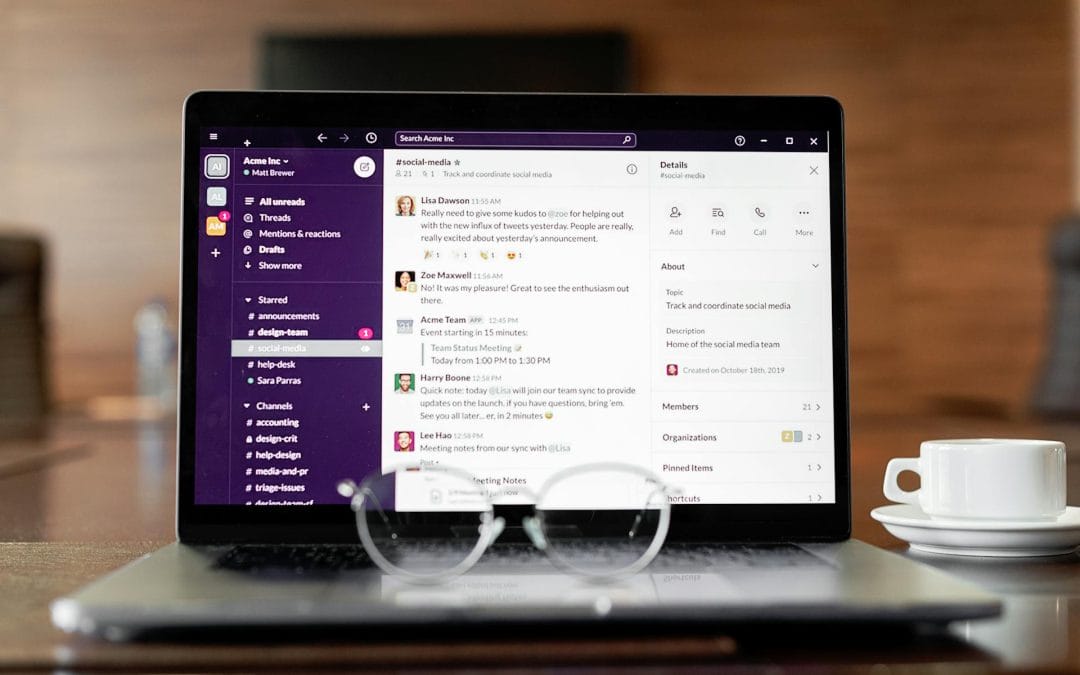
In South African workplaces in 2026, the cost of fragmented attention is no longer abstract. It is measured in lost productivity, elevated absenteeism, and a workforce carrying unnecessary mental strain. Traditional internal communication such as email chains, Slack pings, Teams alerts has become the primary contributor to this strain. The solution lies not in louder messaging or better subject lines, but in a fundamental shift: moving from active, interruptive delivery to the ambient absorption of passive internal communication.
This is the psychological case for passive internal communication. It is not a trend. It is an operational necessity grounded in how the human brain actually processes information under real-world pressure.
The Mental Health Crisis Facing South African Organizations
Recent workplace data paints a clear picture. Over a third of working South Africans, approximately 35%, report severe daily stress levels that directly impair performance and wellbeing. This figure aligns with broader findings from Gallup and local HR analyses showing that excessive workplace stress now forms a structural drag on human capital optimization across sectors.
The economic toll is equally precise. Mental health-related absenteeism and presenteeism cost the South African economy hundreds of billions annually in lost output. For HR Directors and CEOs, the numbers translate into measurable operational risk: higher turnover in high-skill roles, reduced decision quality, and teams operating well below capacity.
The root cause is not the volume of work itself. It is the constant cognitive tax imposed by the tools meant to keep everyone “in the loop.”
Cognitive Load: The Hidden Tax on Every Employee
Cognitive Load Theory, originally developed in educational psychology and now widely validated in workplace studies, distinguishes three types of mental effort:
- Intrinsic load – the inherent complexity of the task.
- Germane load – the effort required to build useful schemas and long-term understanding.
- Extraneous load – unnecessary mental effort created by poor information design or delivery.
Traditional internal communication platforms excel at inflating extraneous load. The average knowledge worker now faces roughly 275 interruptions per day. That includes 117 emails and 153 chat messages. Each interruption triggers what researchers call “attention residue”, the mental fragments of the previous task that linger and degrade performance on the next.
University of California research quantified the recovery cost: it takes an average of 23 minutes and 15 seconds to regain deep focus after a single disruption. Multiply that across hundreds of daily pings and the workday fragments into a series of shallow, reactive moments. The result is not merely inefficiency. It is chronic cognitive fatigue that manifests as anxiety, reduced creativity, and accelerated burnout.
Notification fatigue is not a soft issue. It is a measurable degradation of the organization’s most expensive asset: focused human attention.
Why Active Internal Communication Systems Amplify the Problem
Email and instant messaging were designed for one-to-one or small-group exchange. Scaled across thousands of employees they create an information black hole. Leaders send critical updates hoping for visibility. Employees, overwhelmed by volume, develop sophisticated filtering behaviors—skimming, archiving, or simply ignoring. The signal-to-noise ratio collapses.
Compounding this is the psychological pressure of expected immediacy. Studies consistently show that the mere presence of unread notifications elevates cortisol levels and erodes perceived control. Employees report feeling tethered to their inboxes even during focused work blocks. The system demands constant choice: respond now, defer, or risk missing something important. That choice itself consumes working memory.
The outcome is predictable. Engagement metrics on intranets remain low. Policy acknowledgements hover in the single digits. Compliance training completion rates disappoint. And leadership receives no reliable feedback loop on what was actually absorbed.
Passive Internal Communication: Reducing Load Through Background Osmosis
Passive internal communication operates on a different principle. Instead of demanding active attention, it places essential information into the employee’s peripheral field of view—available for absorption without requiring a decision to engage.
This approach aligns directly with how the brain prefers to operate under load. When information is presented ambiently on strategically placed digital displays, desktop overlays, or dedicated screens employees process it through passive osmosis. The message registers without pulling them out of flow state. No inbox to check. No notification badge to clear. No immediate response required unless the content itself demands action.
The psychological benefit is immediate: extraneous cognitive load drops. Working memory is preserved for core tasks. Stress indicators decline because the environment no longer forces perpetual micro-decisions about information priority.
Corporate Voice was engineered precisely for this operating model. It functions as the organization’s Signal Custodian, delivering verified, time-sensitive information with guaranteed reach while remaining respectfully non-intrusive. Information appears in the employee’s visual field at the right moment, on the right device, and in the right context. Employees absorb updates as they move through their day. Leadership gains certainty that the message landed.
This is not theoretical. It is infrastructure.
Evidence from the Field: South African Organizations That Made the Shift
Real-world deployments confirm the psychological and operational impact.
In the African Bank ICT Security Awareness Campaign, the organization needed to train more than 5,000 employees across head office and a national retail banking network. Traditional email and e-learning modules had delivered near-zero completion rates. Corporate Voice’s strategic desktop pop-up mechanism, smart delivery with snooze functionality, progressive enforcement, and integrated video tracking, changed the outcome completely.
The result: 97% video view rate across all five chapters of the program. Assessment completion rates ranged from 89% to 95%, with branches achieving an average of 94.6%. The Head of Internal Communications noted the transformation: “We went from hoping employees would complete online modules to knowing with certainty that 97% had watched the training and 92% had passed assessments. That level of verified compliance was unprecedented for us.”
Similarly, Eqstra’s rollout of 33 organizational policies required absolute reach and documented acknowledgement from every employee. Email-based distribution had created chaos, chasing, reminders, and uncertain compliance. By shifting to Corporate Voice’s passive delivery infrastructure, Eqstra achieved 99.93% acknowledgement completion. No follow-up emails. No additional cognitive burden on employees. Simply guaranteed absorption of critical policy information.
These are not isolated wins. They represent the repeatable pattern when organizations replace interruptive channels with passive ones: higher completion, lower stress, and restored trust in internal communication.
Full details of both implementations, including exact mechanics and additional metrics, are available in our case studies section.
Operational Recommendations for HR and Leadership Teams
The transition to passive internal communication does not require replacing existing tools. It requires layering a dedicated Signal Custodian that handles the information employees must see, such as compliance updates, policy changes, safety notices, strategic alignment messages, without competing for inbox space.
Begin with a signal audit: map what currently travels via email or chat that actually requires guaranteed reach. Redirect that inventory to passive channels. Measure baseline cognitive load indicators (interruption frequency, reported stress, completion rates) before and after implementation. The data will speak for itself.
South African organizations have an added advantage in this shift. Local infrastructure, local support, and data sovereignty mean decisions can be made with confidence and speed.
From Anxiety to Operational Confidence
Notification fatigue is not an inevitable feature of modern work. It is the predictable outcome of using the wrong delivery mechanism for the job.
Passive internal communication restores the natural balance. It protects cognitive capacity. It lowers the ambient stress that erodes performance. And it delivers the one outcome traditional systems have never reliably achieved: guaranteed reach without adding to the problem.
The organizations that implement this infrastructure first will not merely communicate better. They will operate with clearer alignment, lower friction, and a measurable advantage in human capital optimization.
The infrastructure exists. The psychological case is closed. The only remaining question is how quickly your organization moves the signal out of the inbox and into the background, where it belongs.
Explore the documented results from South African leaders who have already made the shift: corporatevoice.co.za/case-studies/.
Corporate Voice. Passive by design. Certain by delivery.
Book your free demo today.